Taking Time for Self-Care

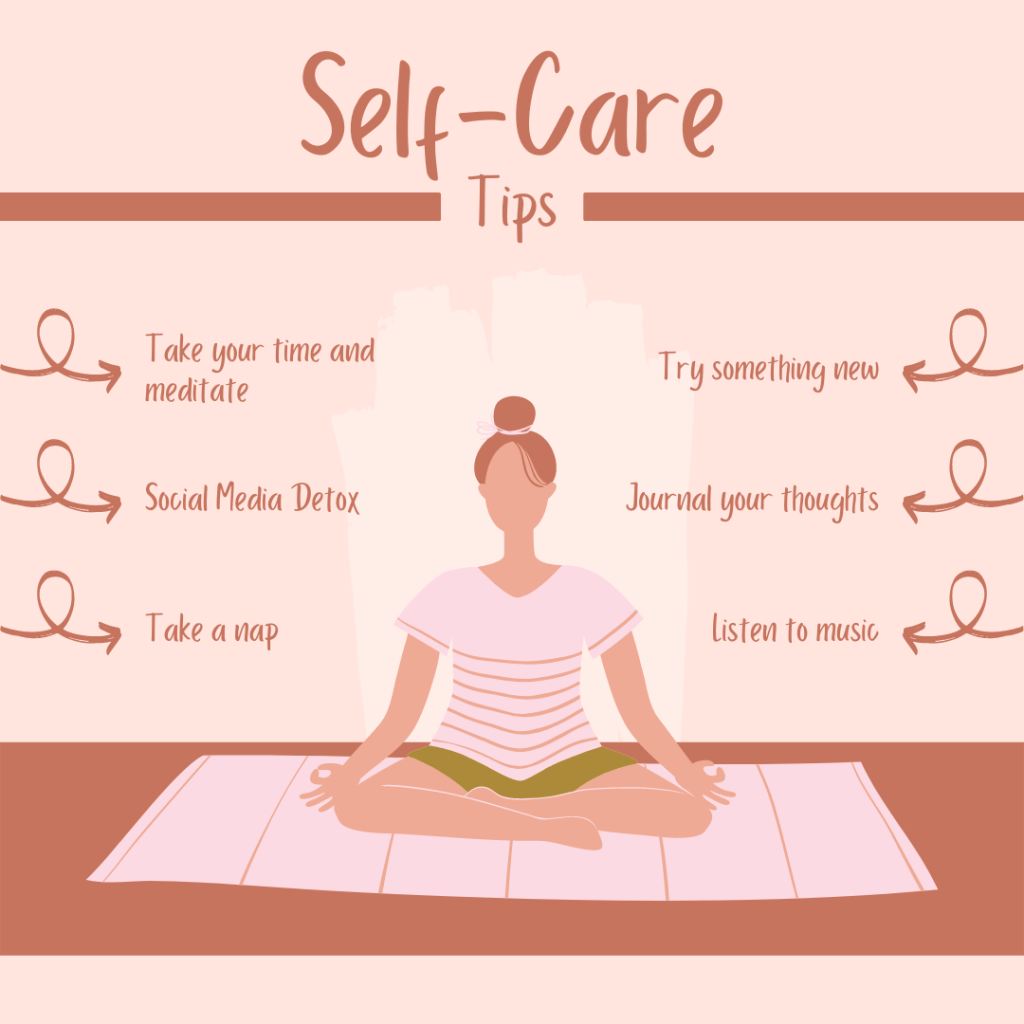
Considering the last two years of the pandemic and our lives changing, it is important to take time for your self-care. Taking care of yourself is more than doing a beauty night to feel better (although that is fun). Self-care is about relaxing, finding time for yourself, doing activities that build up your mind, and taking care of your body. While this topic is broad, this blog post will be used to go over general self-care activities you can do to help you grow as a person. Engaging yourself both physically and mentally is important in the pursuit of self-care.

Let’s look at some of the ways you can take part in self-care:

Mindfulness

Being mindful requires putting a focus on what you are doing or experiencing at a given moment. Mindfulness asks that you experience the moment without any judgment or interpretation. Other aspects of mindfulness include imagery, breathing techniques, etc., to relax and destress.

Being mindful takes practice, when I first started to practice mindfulness, it felt awkward. As I was becoming aware of my environment, I would think to myself, this is what I am feeling right now, the room is hot or cold, and if any sensations were bothering me, I would accept them and then let them go.

Mindfulness exercises include paying close attention to what you are doing and focusing on it one step at a time. This experience can also include paying attention to your five senses in the process.

Being present is also an aspect of mindfulness practice. For example, not thinking about the past or an hour from now. Simply being in the moment and experiencing whatever you are doing at the time.

Accepting who you are is also another method of mindfulness. This involves compassionately acting towards yourself. Always watch your self talk, and if you catch your mind telling you negative things, think would I accept others talking to me in this manner. Chances are the answer will be no.

Exercise

Self-care includes taking care of yourself inside and out. This doesn’t mean that you must have a perfect body, but it does mean that it is beneficial to get out at some point during the day and get your body moving. Even just going for a walk can be helpful. Exercise can improve your mood, and lower stress, while increasing self-confidence.

Other bonuses of exercise include pumping up those endorphins. Physical movement may help to bump up your mind’s natural feel-good chemistry. In addition to this, exercise can play a similar role to meditation. For one thing, you have something positive to focus on, and your body will feel better while forgetting daily irritations.

Rejuvenating your mind

Clearing and rejuvenating your mind can help to reset your mind and clear out the clutter floating around. Let’s face it like a computer, sometimes your mind needs a reset too. A few things you can do to rejuvenate your mind is to try a digital detox. This means staying off social media or technologies that cause stress for a period. Sometimes too much technology (while technology is good) can cause more havoc than help.

Another thing you can try is a gratitude journal. Focusing on simply writing down three to five things that you are grateful for at the same time each day can help you to truly see what is good in your life and can shed more positivity into your daily routine.

Should I Take a Career Break?

So, the question is “Should I take a career break?”. Career breaks are important, and if timed right, they can provide you with experiences you might not have otherwise. While working and building your career are important, taking time off to experience life and take care of yourself are also extremely valuable.

Many people today, work to the point of burnout where their bodies and mind take a turn for the worst. Finding balance in life is crucial, and sometimes cutting back the amount of work you have might be the right thing to do. But let’s focus on what you can do to stay productive and healthy if you do decide to take a career break.

First things first…

Before you go on a career break, make sure that all your major commitments are taken care of, and don’t take on any large commitments within several months of going on your career break. With this being said, the point of a career break is to clear your calendar and make time for yourself. So, ensure that you complete all your commitments, or let others that you expect to be off during a certain period. Not only will this make being off less stressful, but it will also help keep your reputation as a reliable employee intact.

In addition to this after you have announced your career break, ensure that you fill your colleagues in on important information and where projects stand before you leave. Also, have a productive meeting with your manager about why you are leaving and your options for returning to work after your career break. Career breaks typically last between 6 months to a year.

Determining your reason for a career break…

When determining your reasons for taking a break, things you will want to look at are how you are feeling (both physically and mentally), how your work/life balance is and if you need to adjust, if you are on the verge of burnout, or if you feel stuck in your current job, among many more reasons.

Ask yourself the below questions to help guide your reasoning and transition into a career break:

  1. What is my main goal in taking time off?
  2. Am I looking for more downtime or to rediscover certain aspects of myself that I need time for?
  3. Will I be leaving my current job, or will I be looking to come back after time off?
  4. Do I have the financial support needed while taking a career break?
  5. Am I considering self-employment in the future as an aspect of taking a career break?

These are some of the considerations you can ponder before you go full force into your career break. Taking a career break is a big consideration, and to get the most benefits from it you should be prepared and planned out during your time off. This does not mean to say that you should not take some time to simply relax, but the main prospects of career breaks are to realign your life and refresh your perspective.

Planning your career break…

Since you are taking a career break you will want to make sure that you tackle the things you want to accomplish. This could range from taking care of your mental health to traveling the world, or a little bit of in-between.

Things you can do during a career break:

  1. Travel to places you have always wanted to see for an extended period.
  2. Learn a new language or skill.
  3. Selfcare such as exercise, fitness challenges, or relaxation.
  4. Work on a passion project.
  5. Volunteer within your community or abroad.
  6. Get perspective on life and where you want to go with your life.

Regardless of what you choose to do during your time off, you will want to ensure that your goals for your career break are set out and that you will separate from your workplace with everything intact to continue good relationships with your previous colleagues and employers. Taking a career break is important for your well-being and health and should be explored at some point in your career.

What is Happenstance, and How to Make it Work for You

Career planning, guidance, and direction are all major components of everyone’s career journey. Have you ever wished that opportunities would present themselves, or that you had a way to create them? This is where Planned Happenstance comes in. Planned Happenstance was coined by Professor John Krumboltz. To sum it up, Planned Happenstance is searching for opportunities to come to you (Sharf, 2010). Once you understand this method and how it works you might be able to bring opportunities to yourself to help your career.

According to Krumboltz people need to capitalize on their experiences in their lives and take advantage of their life experiences (Sharf, 2010). The more opportunities you create in your life the more chances you will have to succeed in your career. You will want to approach this method with an open mind as to what you can create in your life. As you progress through Planned Happenstance it is important to be comfortable with indecision and options that will come your way (Sharf, 2010).

The Breakdown of Planned Happenstance

Planned Happenstance comprises of five components. Understanding these components will help you be able to gain a greater understanding of why you make certain decisions in your career.

Curiosity – Exploring new opportunities. Seeking out informational interviews, volunteering, and networking are all-inclusive of curiosity and creating opportunities. The mentioned above are just a few methods to explore curiosity, however, you can create and find opportunities with even a simple internet search, and by talking with people. 

Optimism- Looking for new chances to make things happen, that pay off in the long term.

Risk-Taking – This happens when unexpected events happen along your path. This aspect is important because even though you may not reap what you had planned from a particular situation, doesn’t mean that it will not have long-term benefits, that can present other opportunities.

Persistence – Often experienced during setbacks in your career. Being consistent in your career progression and methods is of importance. When you experience a setback, getting back up on your feet and reconnecting with others or searching for other companies to work within your industry would be beneficial.

Flexibility – This comes from dealing with and learning from various events. As mentioned above keeping an open mind and a good attitude will go a long way when it comes to developing your career. The world of work highly values flexible individuals, so adopting and/or learning this trait in your career progression has long-term benefits. Remaining flexible when doing a job search is also a positive way to navigate through the job search process, as it is a chance to learn more about yourself through reflection.

(Sharf, 2010)

Planned Happenstance can have many benefits. Things that can occur because of taking a risk are:

  1. Meeting people that you might not otherwise get a chance to connect with through taking on a meeting or an informational interview.
  2. Unexpected changes in your career, for example, you have a career planning session with your manager or mentor. You have a conversation about where you would like your career to go. A few months later an opportunity arises, and you are mentioned for the opportunity. This conversation led you to a new opportunity.
  3. There could be obstacles in your way. By assessing how you can get around and overcome obstacles, can lead you to new opportunities. Thinking outside the box in this instance helps.
  4. Extracurricular activities such as volunteering gives you chance to not only show off your skills but also gives you a chance to connect with others. Being active in the community can help you build a strong professional reputation. These experiences can also lead to meeting new people and potentially getting a job opportunity that you might not have otherwise heard about.
  5. Exposure to new experiences is another positive of planned happenstance. By getting out and involved in the community, trying new things, and connecting with others you will get an opportunity. You could discover something new about yourself by experiencing new things, which can ultimately lead to new opportunities.  

There are many resources online that can help you incorporate planned happenstance into your life. In some cases, this method can pay off quickly and in others it can take some time. Either way, planned happenstance is a skill that you can learn and that will always help you to gain new opportunities.  

Bibliography

Sharf, R. S. (2010). Krumboltz’s Social Learning Theory . In R. S. Sharf, Applying Career Development Theory to Counseling (pp. 382 – 385). Belmont, CA: Cengage Learning.

How do I Find My Passion?

We all have passions, from knitting to human rights we all have something we love and want to pursue in our lives. But what do you do when you aren’t sure about what passion you should chase? Just simply searching for something to like, is like running on a hamster wheel. Instead, you should actively seek out what gives you a feeling of freedom and expression.

First, consider your why

Thinking about your why is life is a good place to start. While going out and experiencing different activities can help to lead to finding your passion, knowing your why and then narrowing down activities related to finding your why is a good place to start. For example, do you have a particular age group you like to work with? Do you enjoy spending time with children, and enjoy art? If this were the case, have you ever thought of teaching art classes to children?

Sometimes finding your why can be as simple as examining what people often ask your opinion or advice on. But, to take it a step further you ask yourself a few questions to figure out your why. Start with what gives you a feeling of exhilaration. What excites you and motivates you. Nothing is off the table here. If it is an activity or job prospect that makes you feel good and comes with a sense of purpose, then examine it more.

The next question can be what your strengths are. Knowing what your strengths are is one thing, but knowing how to use them and apply them is another asset to discovering your why. Knowing what your strengths are and what activities you can apply them to can help to open new opportunities that you might want to pursue.

Exploration and Planning

With these tools in mind – your strengths and what makes you light up – put them together and narrow down activities and/or careers that might inspire you to examine. When starting, begin by getting your feet wet. Volunteer in short-term obligations, network, conduct informational interviews, and talk to industry professionals who might be able to give you some insight into what you are exploring.

One major tip that can work is to create a mind map. A mind map can be a great way to do a brain dump of all your ideas, strengths, and experiences. You can write out what did and didn’t work. What you enjoyed and didn’t enjoy and write out activities that excited you. Brain dumps and mind maps are also a great way to see where the dots connect between activities and where you might be able to fill in the gaps.

Once you have made your connections, experienced some of what you are interested in, and connected the dots you can begin to move into activities that had the most impact on you. Things to think about in your exploration are:

  • What did I enjoy the most?
  • Where do I feel I can learn and grow?
  • What skills, knowledge, and attributes did I contribute to these experiences?
  • What feedback did I receive from others that can help me guide my decision?

 Answering these questions, while concentrating on your exploration can help you to come up with ideas to expand your purpose search.

In conclusion, it is important to remember that often in our lives we will switch careers a few times during our professional lives. Starting in one career and then moving to another as the course of your life changes is completely normal. The important aspect to consider is that you need to start somewhere that makes you excited, and then gradually grow to your goal.

How to Get Back Up When You Feel Knocked Down

So, I won’t lie, as I write this post, I am in a state of feeling knocked down and belittled. Today was not my shining star moment. I am a true believer that we have total control over what we choose to learn and do with learned life experiences.

Learning from not-so-nice experiences in life is important, but how we choose to grow from them is even more important.

Everything in life has a lesson to learn from, let’s look at some important things you can do to get back up and running when you experience not-so-pleasant experiences in life.

Think about what you can learn – Take into consideration what you want to learn from the experience. Think to yourself, why did this experience occur and what am I meant to learn from it. Evaluating your experiences and reflecting on them can help you pull out the positive meaning of your bad experience. For example, you give a speech, and it doesn’t go as well as you expected. You thought that you had some great content to give to the audience, but their reaction was not as you expected. Perhaps this could be a chance for you to think about how your audience engagement was, or maybe the message was not quite as well targeted to the audience you were meeting with. Seek feedback about why things didn’t go so well and use that feedback as leverage to amp up your next performance.

Revise and Redo – Do you have a second chance with the individuals you are interacting with? If so plan to approach them confidently and try to build collaborative relationships. Perhaps you disagreed with a colleague and the conversation the day before didn’t go over as planned. Reflect on where the conversation didn’t go so well, think about what you could do better next time. This could be anything from improving body language and voice tone to improving your listening skills. Once things cool down, try to reapproach the situation productively and understand what the other person’s intentions are.

Go in with an open mind – Looking for a way to try to avoid feeling knocked down? Go in with an open mind and be prepared to experience things just as they are. While it’s true that there will be times that you can’t avoid being knocked down, you may be able to shake off the feeling if you go in situations taking things in stride. By experiencing things just as they are you can be in the moment and accept situations for what they are. This will bring clarity of mind and active concentration.

While it is true that we all experience not-so-pleasant experiences in life, it is also true that we can reflect and learn from each experience in life. Taking on bad experiences and turning them into positive ones can be an experience that is both healthy and productive.

Learning About Mindful Practices

Mindfulness is a big topic these days as more people are seeking out ways to care for themselves and wanting to lead healthier lives. Mindfulness is a thought process that you follow without judgment, where you are aware of your surroundings and thought processes. It is based on focusing on where you are at the moment and being aware of the present. During mindfulness, you might practice breathing exercises, focus on the texture of items you are feeling, all in a focus to reduce the stress that you are feeling.

Mindfulness can be used to reduce stress, anxiety, among other things. Some of the benefits of mindfulness involve increased attention and awareness, relaxation, and better sleep.

So how can I work on my mindfulness?  

When practicing mindfulness, it can take some time to get skilled at mindfulness, but over time the practice does get easier.

Paying Attention – Take a moment and work to understand what is happening in your surroundings. For example, focus on your senses. What do you smell, feel, hear, and taste? By focusing on these items, you can come into the present moment and focus on where you are and what you are feeling. In a sense, it slows down your mind and keeps you focused on the task at hand.

Being in the moment – By focusing on the moment you are in you can be intentional about what you are doing and what you want to accomplish. This includes thinking about how you are feeling and analyzing what you are experiencing. For example, if you are at dinner with friends, but find your mind wandering to things you have to get done for work. Stop and think to yourself – I am here at dinner now and this is a cherished time with friends. Keep your mind focused on what is in front of you to be in the present.

Breathing – This is rather simple and challenging at the same time. When you are feeling stressed the best thing to do is to stop for a minute, sit down if you can, take a few deep breaths, and feel how the breath feels coming in and out of your body. Breathing brings oxygen to the brain while helping to give you a minute to relax.

Final Word

Mindfulness is a great way to give yourself a minute to stop and think and be in the present. There is much more to know about mindfulness, and the practices listed above are only a few things to get you started. As much as you can in life, work to bring yourself into the present moment by focusing on what is in front of you.

How to Switch Industries Using Transferable Skills

Transferable skills are something that we all have. It is something that when recognized in your talent inventory can help you make a successful career transition. Maybe right now you are thinking, how do I even know where to begin at identifying my transferable skills, and how can I explain to an employer how my transferable skills can even be of help to them.

Let’s look at how you can identify your transferable skills and use them to make a career transition.

Step 1 – Review the job posting and think about what the employer is looking for. For example, they may want someone who has experience compiling data, with the ability to present it. Perhaps you are a recent grad, and you worked in an administrative role, and have experience with presentations in school. While working as an administrator you are typically working with data and preparing to send it to the right people. Well, these skills can be explained by describing the methods you used to compile the data accompanied by your presentation strategies while you were in school.

Typically, we have the skills, and if we can show the value to the employer of how we have gained these skills in the past and how we used them to benefit the party we are assisting, then you have a transferable skill at your disposal to use on a resume, cover letter, or in an interview.

Step 2 – Brainstorming and creating a mind map.Create a mind map and brainstorm on a simple piece of paper. Highlight on the job posting what skills you have already and jot down one or two points of things you have done to qualify for these points. On the skills that you may not have much experience with, think about where the skills you have used can transfer over because the method to do the task required will be able to transfer to the job posting request.

Think about things you have done in volunteering, work settings, or in school that can transfer over. Even if you only have a little bit of the experience necessary, still think of how this skill can tie into the experience the employer is looking for. When it comes to skills like strong writing skills, and you have not done a lot of writing since school, use your academic writing skills as an example.

Step 3 – Putting it all together. Once you have your points and examples clarified write out your experience in a Problem, Action, Result statement (also known as a PAR Statement). Using the writing skill as an example, you might say something along the lines of “Demonstrated strong report writing skills shown through academic writing to provide effective reports based on the complex subject matter, which resulted in providing readers with effective examples and concise information.”

While writing points like this can be daunting when you first get started, it is important to keep in mind that your resume is giving points of what you have achieved and how you can help the employer review your resume. Always keep in mind, what would this employer want to know about me that can help them. Resumes are reviewed in several seconds, so it is important that on the first page you can give the employer a snapshot of what you can provide them with.    

Transferable skills are important and helping an employer to understand what you can do for them, and your achievements are important. You do not have to include every single detail on your resume. The bigger details can be explained in the interview, while the information to draw in the employer can be done on the resume. Remember pointing out transferable skills while switching industries on the resume is what will intrigue the employer to connect further with you.

Can you make your job search more digestible?

Let’s face it, the job search can be challenging sometimes.

But it doesn’t have to be daunting. While the whole job cycle might have its ups & downs and certainly challenges, it provides you with a chance to re-evaluate your skills and career vision.

It is a chance to improve your communication, sharpen your technical skills, connect with new people, and essentially create a new career path.

What if you can make the job search easier for yourself? Do you just sit in front of the computer and apply for jobs? Hiding behind the computer is easy, I know, but how far has it gotten you?

Here are some tips to make the job search a little less tedious:

Get more interviews: Help yourself and get the recruiters to come to you. Post your resume live on job search websites that allow you to post your resume and make it searchable. Make sure that industry keywords are on your resume, so when the recruiter goes to search for candidates, they can find you. Instead of putting your name in the space where they ask you to name your resume, put in the job title you desire and repost your resume every few days. If you don’t repost your resume, it will keep going to the bottom and get buried under everyone else’s resume as they continue to post their own.

Email companies you are interested in and pick up the phone and call them: Many companies have a general mailbox where they accept resumes. Send over a resume and cover letter telling them why you want to work for them. If they don’t have any positions available to meet exactly what you are looking for right now, they might have something similar! This could get you an interview! Sign up for daily job postings, typical I know, but what a better way to keep on top of things than to have them sent to you. Also, don’t just rely on those. There could be other jobs like the one you want that didn’t make the email because of word variations. When searching for a job consider using word variations. For example, “administrative”, “administration” and “admin” or “assistant”. These can each bring up a different list of opportunities

Take on Informational Interviews: An informational interview is a good way to get your foot in the door and connect with individuals within the company.

Things to do when attending this kind of interview:

Research the Company: This provides all you need to know such as what services the company provides. You can also get an idea of what that company culture is like.

Prepare Possible Questions: This allows you to gain information that was not provided or found during your research and gives the employer a view into how you think and work.

Try connecting through the phone or on social media: Keep the connection open with the person who took the time to meet with you. This can be a lead for future opportunities.

How to Market Your Top Talent During a Job Search

When it comes to finding a new job, you can reach your goals quickly if you have a strong understanding of how to effectively market your skills and yourself. Accompanying this there is a need to understand yourself and what you are looking for in your career. If you have a strong self-understanding the easier it will be for you to market your abilities to prospective employers.

The “Great Resignation” that is happening in the job market is making it easier for candidates to find roles, or even have a choice of offers for jobs, this allows candidates to take the time to get into a company that works for them.

Many employers are looking for individuals who can effectively communicate, solve problems, and are also looking for dependable people.  These seem like basic skills that anyone can add to their resume but coming up with actual appliable examples of how you can help employers in this aspect can help you stand out during the job search process.

Getting to Know Yourself and Your Market

Understanding yourself and your market is step one in marketing your talent in the job sphere. Ask yourself some questions. What motivates or inspires you? What are you drawn to? Where do you see yourself going long term? What is my job market like? Knowing what gets you moving to be better and do more can help you understand your market and where you want to go.

Think about the following when getting to know yourself and your next career move:

  • What made you happy at your last job?
  • Was there anything at your last job that made you upset or frustrated?
  • What transferable skills do I have?
  • What are the characteristics of my workplace work for me, and what would I like to see in my next job?
  • What rewards are important for me from a workplace standpoint?

Thinking about these kinds of things should help you brainstorm and get a grasp on what works for you. Make a mind map and jot down your thoughts as you go. This method will help you to understand what makes you happy in a job and it will help to cultivate and carve out what you need in a job and how your skills can help you move forward.  

Marketing Your Skills

Understanding your marketable skills and how to present them to employers is the next step in putting your profile out there to get noticed by employers. Employers are looking for individuals who know how to present themselves in the job market, but also to stakeholders, clients, and customers. If you know how to present yourself to an employer then this will not only prove that you are knowledgeable of yourself and your industry, but it will also prove confidence and strong communication skills – which are skills most employers want in a potential candidate.

When marketing your skills come up with a script that you can do interchangeably when communicating with employers. A few of the things you can do are:

Come up with a strong elevator pitch: Creating you 30 to 90-second elevator pitch will help you to effectively communicate your thoughts. Focus on what the employer is looking for and provide examples of how you can meet the employer’s needs through discussing your education, work experience, and soft skills. Do not retell your resume, but rather give the employer a snapshot as to why you are a good fit for the job.

Brand your skills: Give yourself a brand, create a website or online career portfolio, along with a great LinkedIn profile. Show your work, and what you did to let others know about your expertise. Also interacting with others in your profession using social media is a great way to connect to others and let people know what you are all about in the professional world.

Connecting with Others

Connecting with others is a great way to build your platform and it is also a chance to develop relationships. Never approach a person you are interested in talking to with the mindset as to what they can do for you. Show interest in them and see how you can be of assistance to them. For example, if you see a connection on LinkedIn that has a background like yours, or perhaps you studied at the same university, let them know why you are connecting with them. Be genuine and strike up a conversation!

Another method of connecting is to volunteer and get involved with your local community. Get to know others in the community that you want to be involved with. That could be anything from volunteering to rehome dogs and cats by doing their social media, to helping a non-profit by volunteering to be their receptionist for a few hours a week. This will get you to connect with people who are in your area of interest and could potentially lead to future employment.

Finally…

Always keep your mind open, let others know about you and your abilities. Network, connect and share your ideas and knowledge on social media. Marketing yourself is just as much about letting others know who you are, as it is getting to know about others.

Networking Hacks: Myths and Facts

Networking is the most tedious aspect of career-building even to the most seasoned professionals. Networking is now more important than ever. It is vital from the start to the end of your career. If your career is feeling stuck, boring, or unaccomplished joining some networking groups with a planned objective can significantly change your opportunity.

When it comes to networking several common myths surround this issue, let’s read further to learn more about these.

Myths and Facts

Myth: I should connect with as many people as possible.

Fact: You should have a strategy when you network. Choose 2 or 3 people you connected with and keep in touch with them. Always ensure that when you are giving out a business card to someone you are making a positive impression while building a connection. Email them the 2nd or 3rd day after the event.

Myth: Networking doesn’t work; it’s a waste of time.

Fact: Networking does work; it’s about building your professional network over time. Very rarely will networking get you results overnight. But it will always pay off based on who you know in the long term.

Myth: Networking is only for accomplished professionals.

Fact: You should start networking from your first year of college. Opportunities are out there for students! This is the best time to test out different areas of your field and get to know people and build your professional network. If you are more advanced in your career, there is never any time that is too late to begin networking, and don’t wait until you are laid off to start!

Myth: I don’t need a business card.

Fact: Yes, you do! Think about it. We don’t carry around our resume! A business card simply made from a local vendor can be a great way for people to know who you are. Include your name, contact info, professional qualifications, field, and social media links.

Myth: You should attend as many events as possible.

Fact: No! Research the events before you attend! See what kind of people are going, check the venue out. Is this a place you can effectively communicate in? Are the people going networking with the same goals?

Myth: Networking is only for finding a job.

Fact: While networking can lead to a job, networking is used to make professional connections and build your network. Professional relationships like any other relationship, need time and effort.